
Cost of Living in Bangkok in 2026: A Practical Guide for Expats
Bangkok offers a wide range of lifestyles and living costs, making it possible to live comfortably on very different budgets. Your actual cost of living in Bangkok will depend largely on where you choose to live, the type of property you rent or buy, how often you eat out, and how you travel around the city.
For many expats, housing is one of the biggest monthly expenses. A modern one-bedroom condo near a BTS station in central Sukhumvit can cost significantly more than a similar property farther from the city center. At the same time, choosing the right neighborhood can reduce commuting time and transportation expenses while giving you better access to restaurants, shopping malls, international schools, and everyday conveniences.
This guide breaks down the realistic cost of living in Bangkok in 2026, with a particular focus on housing costs, popular neighborhoods, transportation, food, utilities, and example monthly budgets.
Whether you are relocating to Bangkok for work, moving with your family, or considering staying in Thailand long term, understanding these expenses can help you choose both the right budget and the right place to live.
Bangkok Cost of Living at a Glance
As a practical starting point, a single person may spend around THB 30,000–45,000 per month on a budget-conscious lifestyle or THB 50,000–80,000 for greater comfort in a central location. Couples may need approximately THB 70,000–120,000 per month, while family budgets commonly start from THB 100,000 and can rise significantly depending on housing, transportation, and international school fees.
These figures are illustrative monthly estimates rather than fixed prices. Actual expenses depend heavily on rent, neighborhood, household size, commuting habits, dining preferences, and lifestyle choices.
How Much Does It Cost to Live in Bangkok in 2026?
The amount you need each month depends heavily on your lifestyle.
Someone living in a compact condo outside Bangkok’s central business districts, eating mostly local food, and using public transportation will have very different expenses from someone renting a luxury condominium in Thonglor or Phrom Phong.
A useful way to think about your Bangkok budget is to understand the main categories of spending. Housing refers to your rent whether you choose a condo or a house. Utilities include electricity, water, internet, and mobile phone costs. Food covers groceries, local meals, restaurants, and cafés. Transportation includes BTS, MRT, taxis, and ride-hailing services. Lifestyle expenses include shopping, entertainment, fitness, and leisure activities. Other expenses may include insurance, household items, and personal spending.
Among all these categories, housing is usually the most important factor because rental prices vary significantly depending on the neighborhood, property size, building quality, and proximity to public transportation.
This is why choosing where to live in Bangkok can have just as much impact on your monthly budget as your daily spending habits.
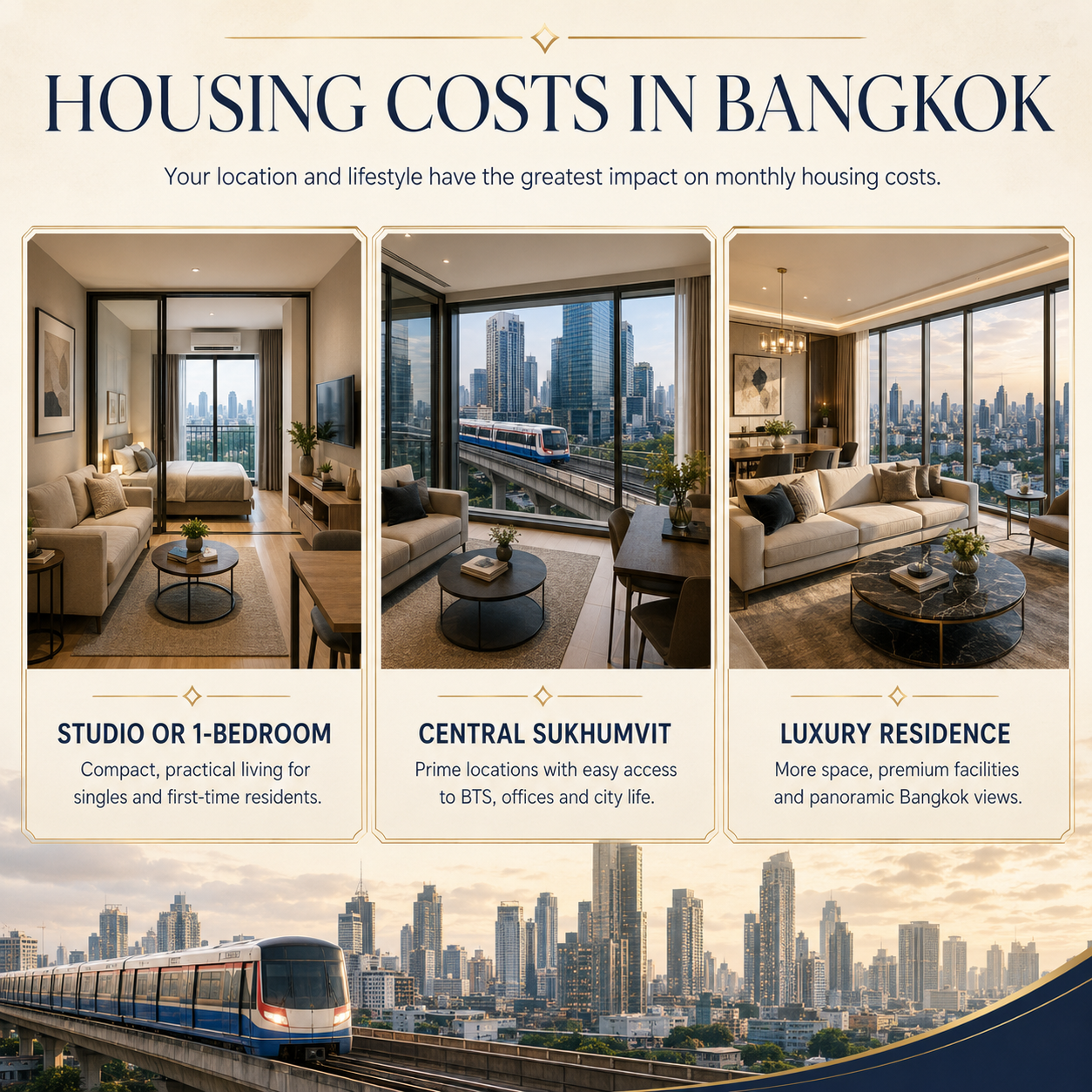
Housing Costs in Bangkok
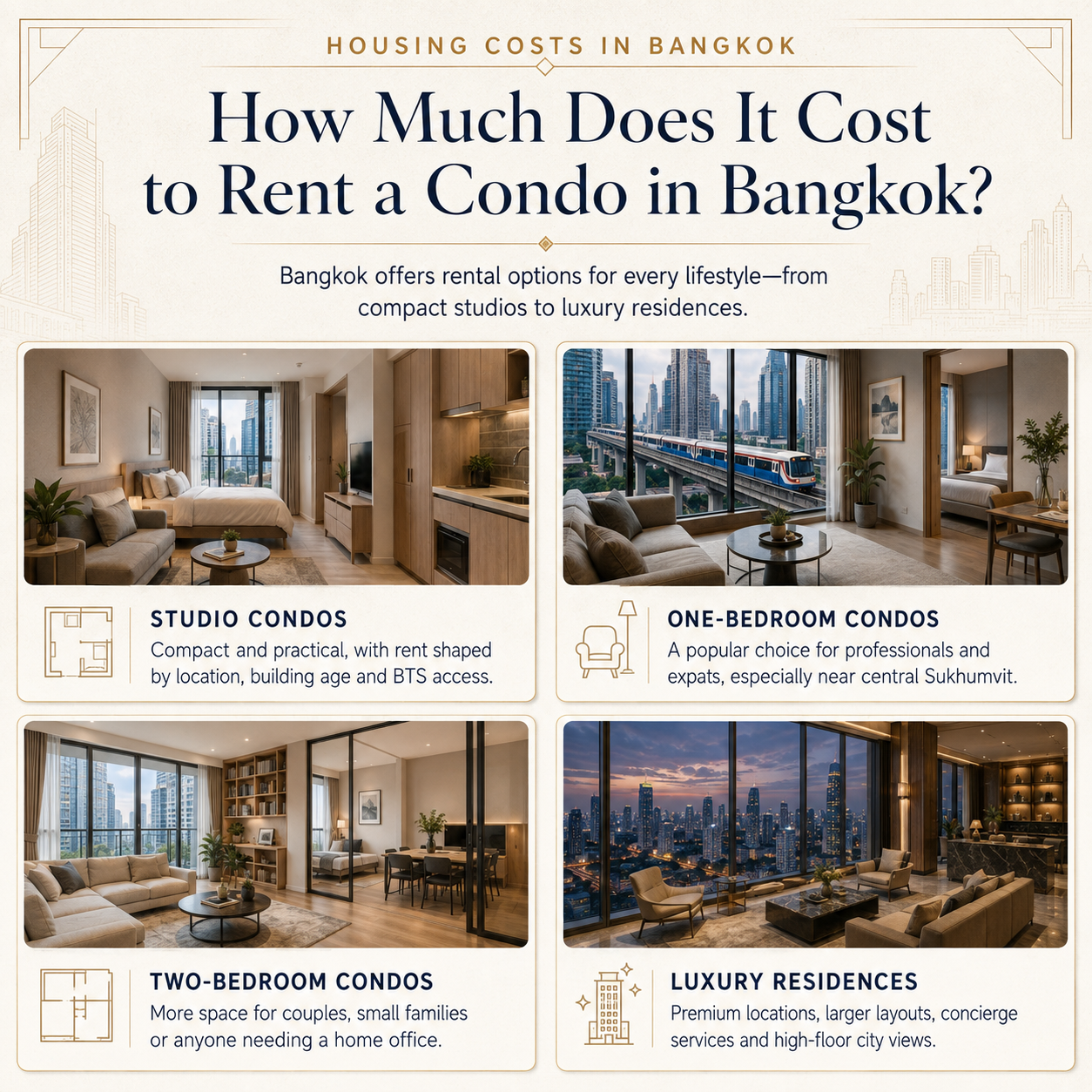
How Much Does It Cost to Rent a Condo in Bangkok?
Bangkok’s condominium market offers a wide range of options, from compact studio units to large family residences and high-end luxury properties.
In general, rental prices increase as you move closer to central business districts and major BTS stations. Studio apartments are usually the most affordable type of housing and are often chosen by students, young professionals, or people who spend little time at home. These units are typically small but practical, and their price depends heavily on location, building age, and distance to public transport.
One-bedroom condos are the most popular option among single professionals and expats. In central Sukhumvit areas, especially near BTS stations, these units tend to be more expensive. However, if you move a few stations away from the city center, you can often find significantly larger spaces for the same budget.
Two-bedroom condos are commonly chosen by couples, small families, or professionals who need a home office. In this category, price differences between neighborhoods become more noticeable, especially when comparing central areas with outer Sukhumvit zones.
Luxury condos are concentrated in areas such as Phrom Phong, Thonglor, Asoke, Chidlom, and other central business districts. These properties often include larger layouts, premium facilities, concierge services, private lifts, high-floor views, and modern interior design. As a result, they sit at the top end of Bangkok’s rental market.
What Affects Condo Rental Prices in Bangkok?
Two condos with similar sizes can have very different rental prices depending on several key factors.
One of the most important factors is how close the property is to BTS or MRT stations. The closer the access, the higher the rental price tends to be. The neighborhood itself also plays a major role, as central areas are generally more expensive than suburban zones.
Building age is another important factor. Newer buildings often come with modern facilities, but older buildings may offer larger living spaces at a lower price. Unit size and layout also affect value, as well as the floor level and view from the unit.
Furniture condition and interior design can also influence pricing, especially in fully furnished units. Facilities such as swimming pools, gyms, co-working spaces, and security systems also add value. Parking availability is another consideration, especially for residents who own cars.
Finally, building management quality and overall supply and demand within the project can significantly affect rental prices.
It is also important to understand that newer buildings are not always better value. Some older condominiums in Bangkok offer much larger units compared to modern developments, while newer projects may provide better facilities and more convenient locations.
For tenants, focusing only on monthly rent can be misleading. It is important to also consider space, commuting time, and daily convenience when comparing properties.
Cost of Living by Bangkok Neighborhood
Location is one of the most important factors affecting both housing costs and lifestyle expenses.
Bangkok does not have a single “best” neighborhood. The right area depends on your lifestyle, workplace, transportation needs, family situation, and budget.
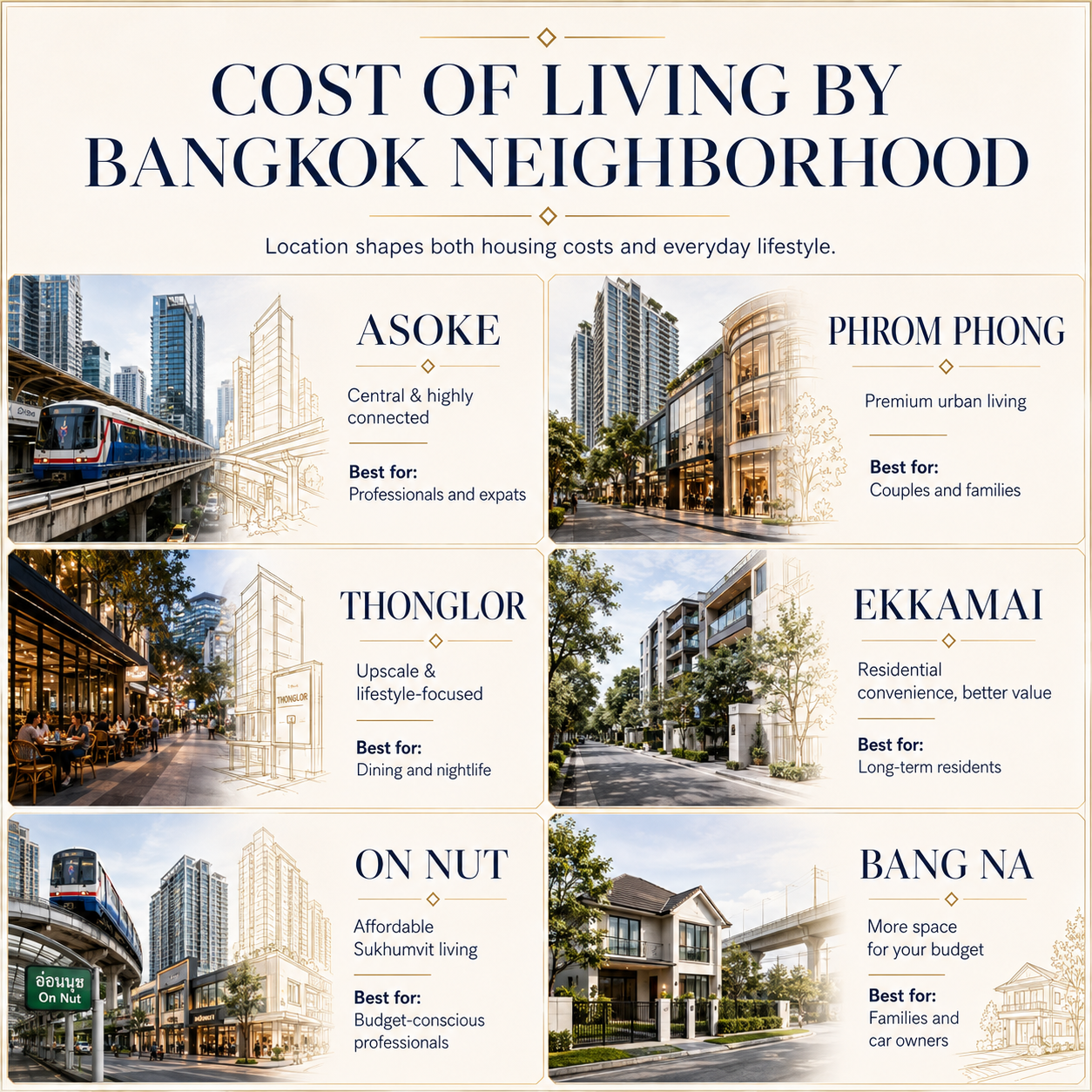
Asoke: Central and Highly Connected
Asoke is one of the most convenient areas in Bangkok for professionals. It is directly connected to both BTS Asok and MRT Sukhumvit, making it extremely easy to travel around the city.
Residents in this area have quick access to office buildings, Terminal 21 shopping mall, restaurants, hotels, and other parts of Sukhumvit. Because of its central location and strong transport connections, rental prices in Asoke are generally higher than in areas farther along the BTS line.
Best for: Professionals, expats, and residents who prioritize transportation convenience.
Phrom Phong: Premium Urban Living
Phrom Phong is one of Bangkok’s most established upscale residential neighborhoods. It is known for luxury condominiums, high-end shopping malls, international restaurants, and a strong international community, especially Japanese residents.
Properties near BTS Phrom Phong, especially those within walking distance of major lifestyle destinations, are usually among the most expensive in Bangkok’s rental market.
Best for: Professionals, couples, and families looking for premium central living.
Thonglor: Upscale and Lifestyle-Focused
Thonglor is widely known as one of Bangkok’s most fashionable residential areas. It offers a wide variety of restaurants, cafés, bars, wellness centers, and modern condominium developments.
Living close to BTS Thong Lo or in the most popular residential streets of Thonglor is generally more expensive than living farther east along Sukhumvit.
Best for: Professionals and expats who prioritize dining, nightlife, and lifestyle.
Ekkamai: Residential Convenience with Better Value
Ekkamai is located next to Thonglor and offers a similar urban lifestyle but with a slightly quieter residential atmosphere.
The area includes condominiums, houses, cafés, restaurants, and convenient BTS access. It is often chosen by people who want to stay close to Thonglor but prefer more housing options and slightly better value.
Best for: Professionals, couples, and long-term residents.
On Nut: Affordable Sukhumvit Living
On Nut is located further east along the Sukhumvit BTS line and offers significantly better value in terms of space and rental price.
The area is popular among younger expats and professionals who want BTS access without paying central Sukhumvit prices. It includes supermarkets, local restaurants, cafés, shopping areas, and modern condominium developments.
Best for: Budget-conscious professionals, younger expats, and long-term residents.
Bang Na: More Space for Your Budget
Bang Na offers a more suburban residential lifestyle compared to central Sukhumvit. The area includes condominiums, houses, and larger residential properties, making it especially suitable for families or people who need more space.
It also provides access to shopping malls, international schools, and major roads, which makes it practical for households that use cars regularly.
Best for: Families, car owners, and residents looking for larger homes.
Comparing Bangkok Neighborhoods
Instead of using a table, it is easier to understand Bangkok neighborhoods by comparing them in terms of lifestyle and cost level.
Asoke is considered a high-cost central area with a strong focus on convenience and is best suited for professionals. Phrom Phong is a premium neighborhood that combines luxury living with an international lifestyle and is popular among expats and families. Thonglor is also a premium area but is more focused on dining, nightlife, and lifestyle experiences, making it ideal for professionals.
Ekkamai sits in the mid-to-high cost range and offers a more residential atmosphere while still being close to central Bangkok, making it suitable for couples and professionals. On Nut is more affordable and provides good value for money, which makes it popular among younger expats. Bang Na is also moderately priced but offers more space and a suburban lifestyle, making it ideal for families.
For a more detailed comparison, see our Best Areas to Live in Bangkok guide.

Food and Dining Costs in Bangkok
Bangkok offers one of the widest ranges of food prices in Asia.
A local meal or food court lunch can be very affordable, while international restaurants and fine dining can significantly increase monthly expenses.
Local food and food courts are usually the most budget-friendly options. Many residents who regularly eat Thai food can keep their food expenses relatively low without needing to cook at home every day.
In contrast, central areas such as Thonglor, Phrom Phong, and Asoke offer a large number of international restaurants and specialty cafés. Frequent dining in these areas can increase monthly food costs significantly.
Groceries also vary depending on the type of products you buy. Local ingredients are generally affordable, while imported products such as cheese, wine, and specialty foods can be much more expensive. Expats who prefer imported groceries should take this into account when planning their monthly budget.
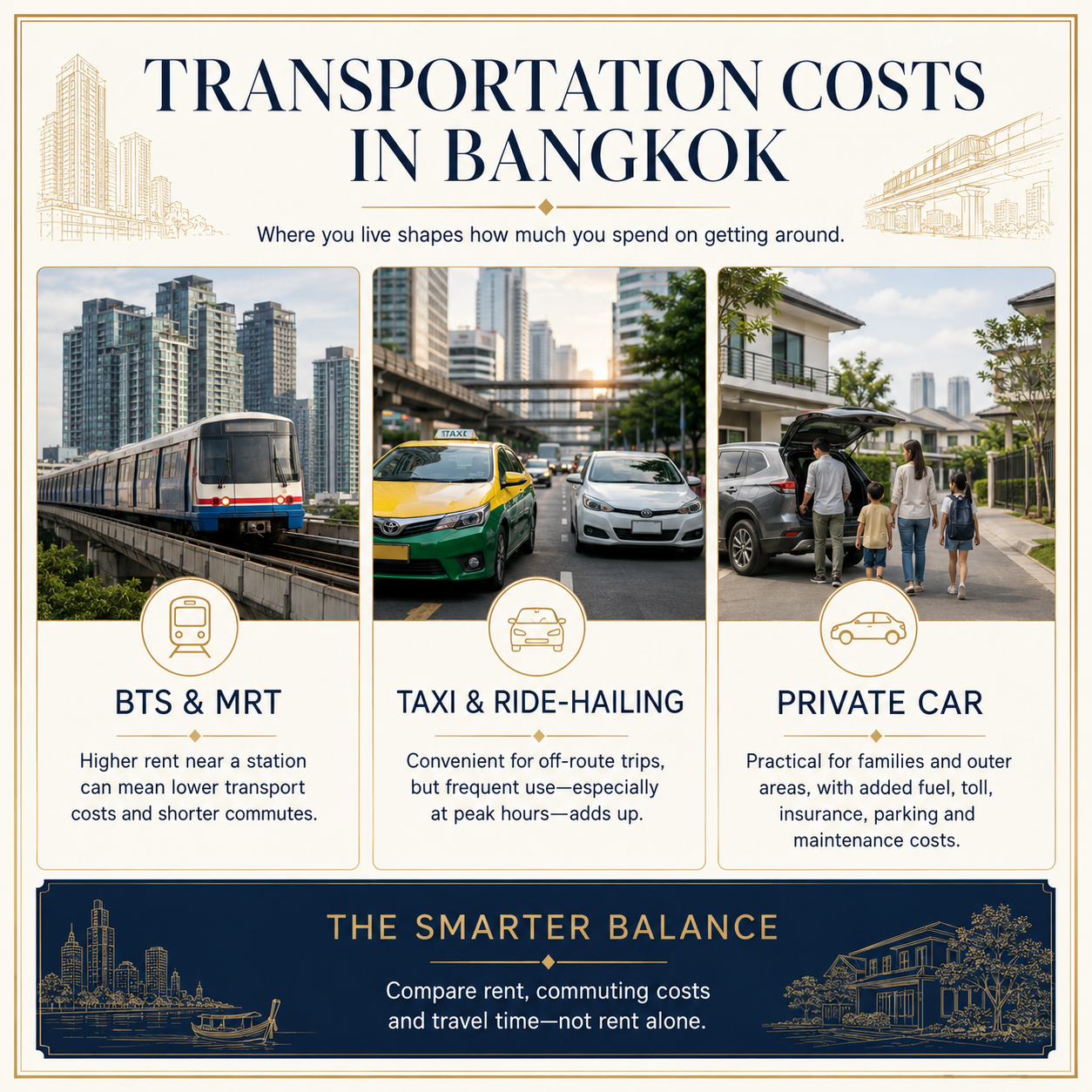
Transportation Costs in Bangkok
Where you live in Bangkok directly affects how much you spend on transportation.
The BTS and MRT systems are the main transportation options for many residents living in central areas. Living within walking distance of a station may increase rent, but it can reduce the need for taxis and private vehicles.
For current ticket prices and route planning, check the official BTS route and fare planner and the Bangkok MRT fare calculator before estimating your monthly transportation budget.
Taxis and ride-hailing services are widely available and useful for destinations not connected to rail lines. However, frequent use, especially during peak hours, can increase monthly transportation costs.
Car ownership adds additional expenses such as fuel, tolls, insurance, maintenance, and parking. For people living near BTS or MRT lines, owning a car may not be necessary. However, for families living in areas like Bang Na, having a car can be more practical.
This shows why housing decisions should not be based only on rent. A slightly more expensive property in a well-connected location can reduce transportation costs and save commuting time.
Utilities and Everyday Expenses
Utilities in Bangkok are generally affordable, but electricity costs can vary depending on air-conditioning usage.
Monthly household expenses typically include electricity, water, internet, mobile phone plans, laundry, household supplies, fitness memberships, and streaming services.
Air conditioning is usually the largest utility cost, especially during hot months. The final electricity bill depends on unit size, number of occupants, air-conditioner efficiency, and how many hours it is used each day.
When renting a condo, it is also important to check whether utilities are charged at government rates or through the building management, as this can affect total monthly costs.
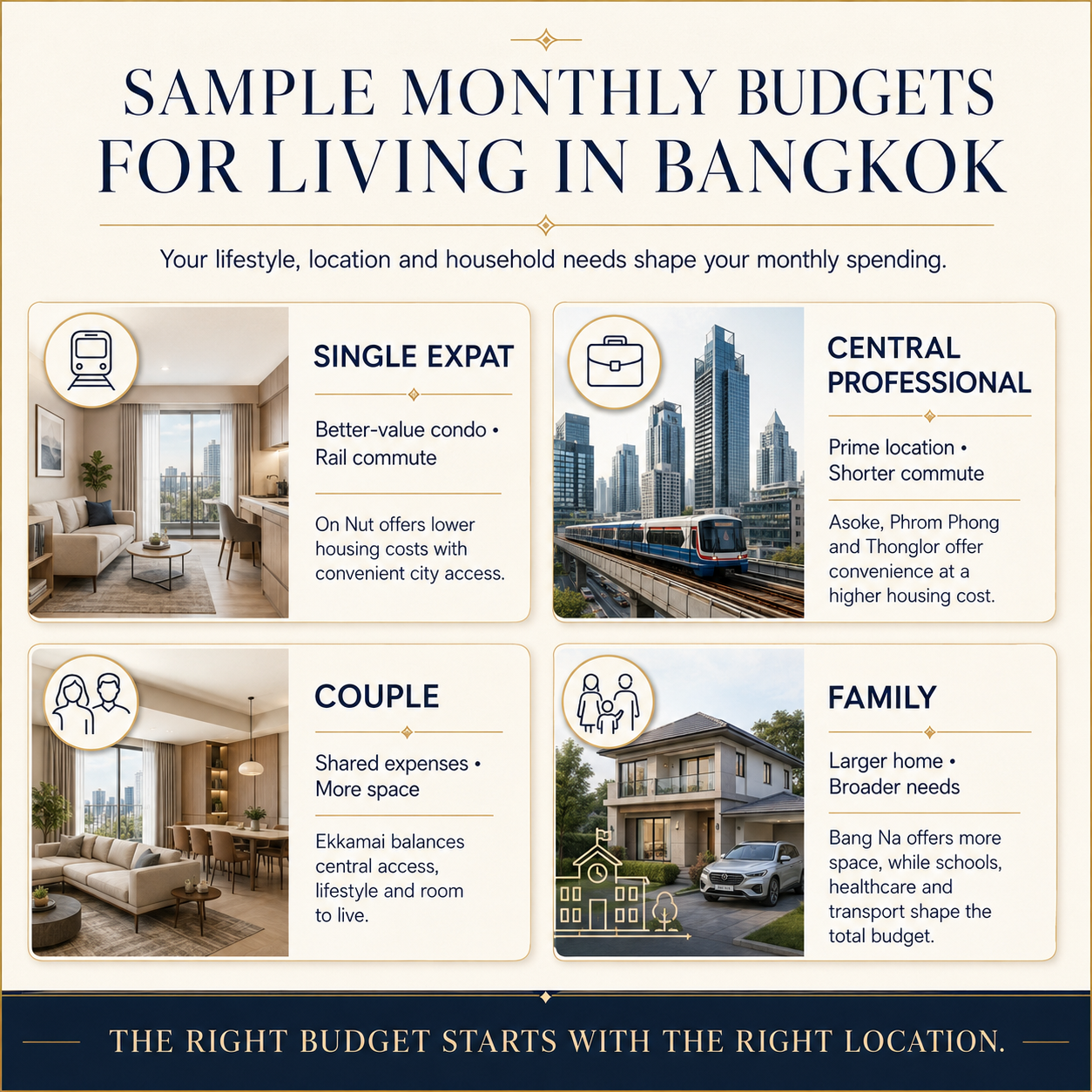
Sample Monthly Budgets for Living in Bangkok
Budget-Conscious Single Expat: THB 30,000–45,000+ per month
This budget may suit someone renting a compact condominium in an area such as On Nut or Bang Na, using BTS or MRT, eating mostly local food, and keeping entertainment and imported groceries moderate.
Professional Living in Central Bangkok: THB 50,000–80,000+ per month
A professional living in Asoke, Phrom Phong, Thonglor, or Ekkamai will usually spend more on housing, dining, and lifestyle. However, living closer to work may reduce commuting costs and save considerable travel time.
Couple Sharing Expenses: THB 70,000–120,000+ per month
Couples may share rent and utilities while choosing a larger one- or two-bedroom condominium. The final budget depends on location, dining habits, transportation, and how frequently they use premium services or entertainment.
Family Household: THB 100,000–180,000+ per month
Families usually need larger housing and must consider groceries, transportation, healthcare, activities, and school access. This estimate excludes international school tuition, which can substantially increase the household budget.
Renting vs Buying a Condo in Bangkok
For expats planning to stay in Bangkok, one important decision is whether to rent or buy a property.
Renting is usually better for people who are new to Bangkok, planning a short stay, or still exploring different neighborhoods. It offers flexibility and allows residents to experience different areas before making a long-term decision.
Buying may be suitable for those planning to stay in Thailand long term, who want to own property, and who have already identified their preferred neighborhood. However, foreign ownership rules and purchasing costs should be carefully considered.
If you are considering ownership, read our complete guide to buying property in Bangkok as a foreigner, including ownership rules, costs, due diligence, and the transfer process.
How to Choose the Right Bangkok Neighborhood for Your Budget
The cheapest property is not always the best value.
When choosing where to live, it is important to consider distance to work, BTS or MRT access, commute time, lifestyle preferences, property size, family needs, school access, pet policies, parking availability, car ownership, nearby restaurants, shopping options, and expected length of stay.
For example, someone working in Asoke may benefit from paying more to live nearby rather than spending time and money commuting. A family needing more space and school access may find better value outside central Sukhumvit.
There is no single correct answer. The goal is to find the right balance between housing cost, convenience, space, and lifestyle.
For a detailed comparison, see our Best Areas to Live in Bangkok guide.
Is Bangkok Affordable for Expats in 2026?
Bangkok can be affordable or expensive depending on lifestyle.
Premium areas like Phrom Phong and Thonglor offer luxury living, while areas further along the BTS and MRT lines provide better value. Families may find more space in suburban areas outside the central business districts.
This flexibility is one of Bangkok’s biggest advantages.
Instead of asking whether Bangkok is cheap or expensive, the better question is which area offers the right lifestyle for your budget.
For most expats, housing and location are the most important factors in determining overall cost of living.
Frequently Asked Questions About the Cost of Living in Bangkok
How much money do you need to live comfortably in Bangkok?
The amount depends on housing, lifestyle, and location. Living outside central areas and eating local food can significantly reduce monthly expenses compared to luxury central living.
Is ฿50,000 per month enough to live in Bangkok?
It can be enough for a single person depending on rent and lifestyle choices. Housing is usually the biggest factor affecting how far the budget goes.
How much does it cost to rent a condo in Bangkok?
Rental prices vary based on location, size, building age, facilities, and proximity to public transport. Central areas are generally more expensive than outer districts.
Which areas of Bangkok offer better value?
Areas farther from the city center, such as On Nut and Bang Na, often provide more space for the same budget compared to central Sukhumvit.
Is Bangkok expensive for expats?
It depends on lifestyle. Local food and public transport are affordable, but luxury housing and imported goods can increase costs significantly.
Is it better to rent or buy a condo in Bangkok?
Renting is better for flexibility, especially for newcomers. Buying is more suitable for long-term residents who understand the market and legal requirements.
Find the Right Home for Your Bangkok Lifestyle
Understanding the cost of living in Bangkok is not only about daily expenses but also about choosing the right place to live.
A central condo may cost more but reduce commuting time. A suburban home may offer more space for the same budget. Every lifestyle has different priorities.
The right neighborhood should match your budget, lifestyle, and long-term plans.
If you are planning to move to Bangkok, Cherry Property Bangkok can help you find the right area and property based on your needs.